
A cowgirl is a woman who works with cattle and horses on ranches in the American West: the female equivalent of a cowboy. By extension, the word also describes rodeo riders, heroines of Wild West shows and western films, and, today, a distinctive way of dressing: cowboy boots, a hat, a western shirt and jeans.
Behind the image is a real history, complete with names, dates and a few tragedies. Here’s where the cowgirl comes from, how she became an icon, and how to wear her style in 2026.
Cowgirl: definition and origin of the word
The English word cowgirl combines cow and girl, following the model of cowboy. Strictly speaking, a cowgirl (also sometimes written as “cow girl”, or called a “cowboy girl”) is a woman who herds, gathers and cares for cattle on horseback. More broadly, she is the female figure of western culture, whether she’s a rancher, rodeo champion, country singer or simply a fan of the style.
The word was already in use in English in the 1880s, but took on its modern meaning in the very late 19th century, when women from ranches began performing in public. The Encyclopedia of Oklahoma History sums it up well: the word was in use, but Lucille Mulhall was the one who brought it to national attention. We’ll come back to her below.
In English, the word is “cowgirl”, with the plural “cowgirls”. It has established itself without a translation: “female cattle herder” exists, but it doesn’t evoke the American West, its wide-open spaces or the look associated with a western cowgirl.
Cowboy and cowgirl: the same life, not the same standing
On paper, the difference between a cowboy and a cowgirl is gender. In practice, women on ranches often did the same work as men: riding, branding calves, mending fences and driving herds. They did it alongside running the household, and without receiving the recognition given to cowboys.
This context matters. The American West was also ahead of its time on some rights: the Wyoming Territory granted women the right to vote in 1869, long before the rest of the United States. The cowgirl emerged in this harsh society, where a woman capable of running a ranch could earn a place she wouldn’t have had in the East.
Wild West shows give rise to the first stars
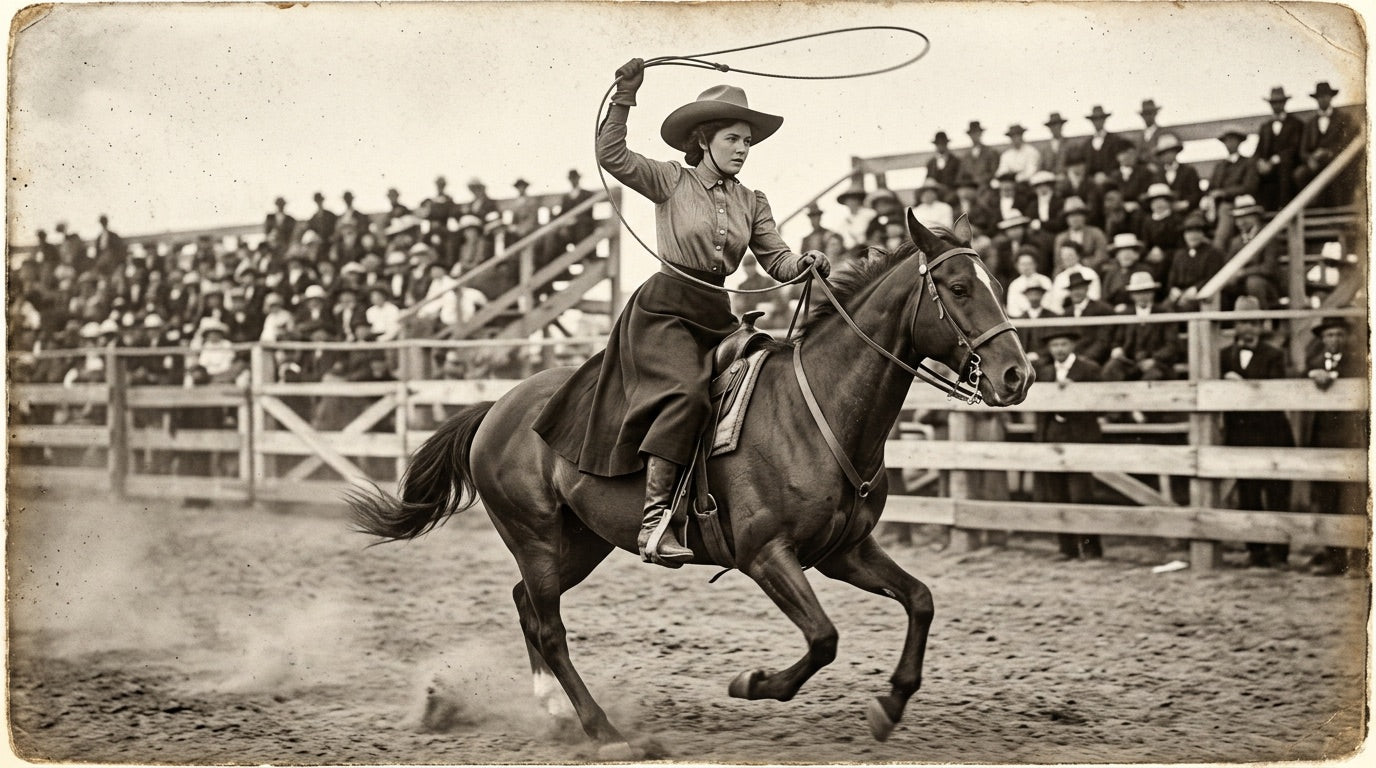
In the late 19th century, the West began to put on a show. The Wild West shows were travelling spectacles featuring shooting, riding, roping and re-enactments. They toured the United States and then Europe. For the first time, women showed audiences what they could do on horseback, and the public loved it.
Annie Oakley, Buffalo Bill’s sharpshooter
Born in Ohio in 1860, Annie Oakley joined Buffalo Bill’s Wild West in 1885 with her husband, sharpshooter Frank Butler. A year earlier, the Lakota leader Sitting Bull had nicknamed her “Little Sure Shot”. The name stuck.
She performed at the 1889 Paris World’s Fair, among other events, and left the troupe for good in 1901 after a train accident. Annie Oakley wasn’t a cattle rancher, but she established the image of a woman of the West: skilful, independent and able to beat men at their own game.
Lucille Mulhall, the first “cowgirl”
Lucille Mulhall was born in 1885 on her family ranch in Mulhall, Oklahoma. From 1899, she performed in her father’s Wild West show, roping and catching steers as skilfully as the cowboys. She later became a star of the Miller brothers’ 101 Ranch Wild West Show.
She is most often described as the first woman to be called a “cowgirl”. According to the Encyclopedia of Oklahoma History, Theodore Roosevelt is said to have given her the nickname after seeing her ride at the Mulhall ranch. The story often told alongside it, about roping a wolf to impress the future president, is more legend than established fact.
What is certain is her career: Lucille Mulhall formed her own troupe in 1913, produced her own rodeo in 1916 and was inducted into the National Cowgirl Hall of Fame in 1977, long after her death in 1940.
Women’s rodeo: from a golden age to a ban
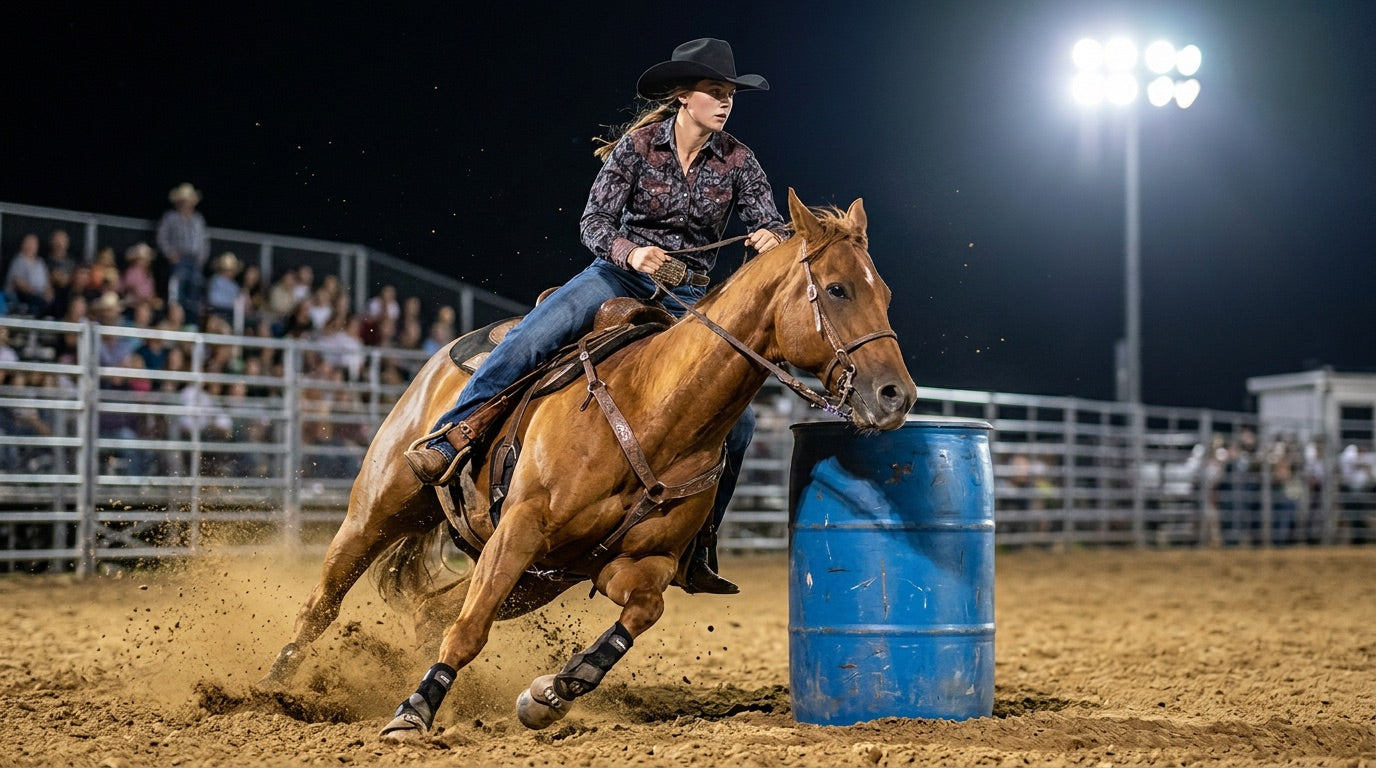
By the early 20th century, women were doing more than performing in shows. They entered the arena to compete, including in some of the most dangerous events, such as riding untamed horses, known as bronc riding.
Prairie Rose Henderson and the pioneers
Prairie Rose Henderson is thought to have been the first woman to compete in a bronc riding event at Cheyenne Frontier Days in Wyoming. Sources differ on the year, giving either 1899 or 1901, but not on what she did: she opened the door for a whole generation of horsewomen.
Among them was Fannie Sperry Steele, crowned champion bronc rider at the Winnipeg Stampede in 1913. Around the turn of the century, horsewomen adopted divided skirts, split so they could ride astride rather than sidesaddle. This practical detail already pointed towards the cowgirl’s future wardrobe.
1929: the death of Bonnie McCarroll
Bonnie McCarroll was one of the rodeo stars of the 1920s. A regular at the Pendleton Round-Up in Oregon since 1915, she won the saddle bronc title two years in a row, in 1921 and 1922. In 1922, she also won at Madison Square Garden in New York and at Cheyenne Frontier Days.
On 19 September 1929, at the Pendleton Round-Up, she was thrown by a horse named Black Cat. She suffered serious head injuries and died eleven days later, aged 32. It was meant to be her last competition before retirement.
The shock was immense. Women’s bronc riding was dropped from the Pendleton programme, and women were gradually excluded from “rough stock” events (untamed horses and bulls), which were considered too dangerous. Other factors also played a part, including the rise of rodeos organised by East Coast promoters, but the accident remains a symbol of this setback.
1948: cowgirls form their own association
Rather than wait to be given their place back, horsewomen organised themselves. On 28 February 1948, 38 women met in San Angelo, Texas, and founded the Girls Rodeo Association (GRA). In 1981, it became the Women’s Professional Rodeo Association (WPRA).
The association describes itself as the oldest women’s sports organisation in the United States and the only one entirely run by women. Today, it oversees barrel racing, a speed event in which riders race around three barrels, which has become the cowgirls’ signature event.
The Hollywood and country cowgirl
On screen and on the radio, the cowgirl took on a new look. She became a popular, smiling, singing heroine, wearing embroidered outfits that still inspire fashion today.
Dale Evans, “Queen of the West”
Born in 1912, Dale Evans made her first film alongside Roy Rogers in 1944, The Cowboy and the Senorita. The duo became legendary: he was the “King of the Cowboys”, and she the “Queen of the West”. They married on 31 December 1947.
From 1951 to 1957, the couple starred in the television series The Roy Rogers Show. Dale Evans wrote its theme tune, “Happy Trails”. She was inducted into the National Cowgirl Hall of Fame in 1995 and died in 2001. Her embroidered, fringed western stage outfits established the image of a glamorous cowgirl.
Patsy Montana and “I Want to Be a Cowboy’s Sweetheart”
In 1935, singer Patsy Montana recorded “I Want to Be a Cowboy’s Sweetheart”, an upbeat song in which she yodels about wanting to live the life of the West. It made her the first female country artist to sell a million records.
This success matters in the history of the cowgirl: it proved that a woman could carry the western imagination on her own, on stage and on record. Patsy Montana was inducted into Nashville’s Country Music Hall of Fame in 1996.
The cowgirl today: from Beyoncé to coastal cowgirl
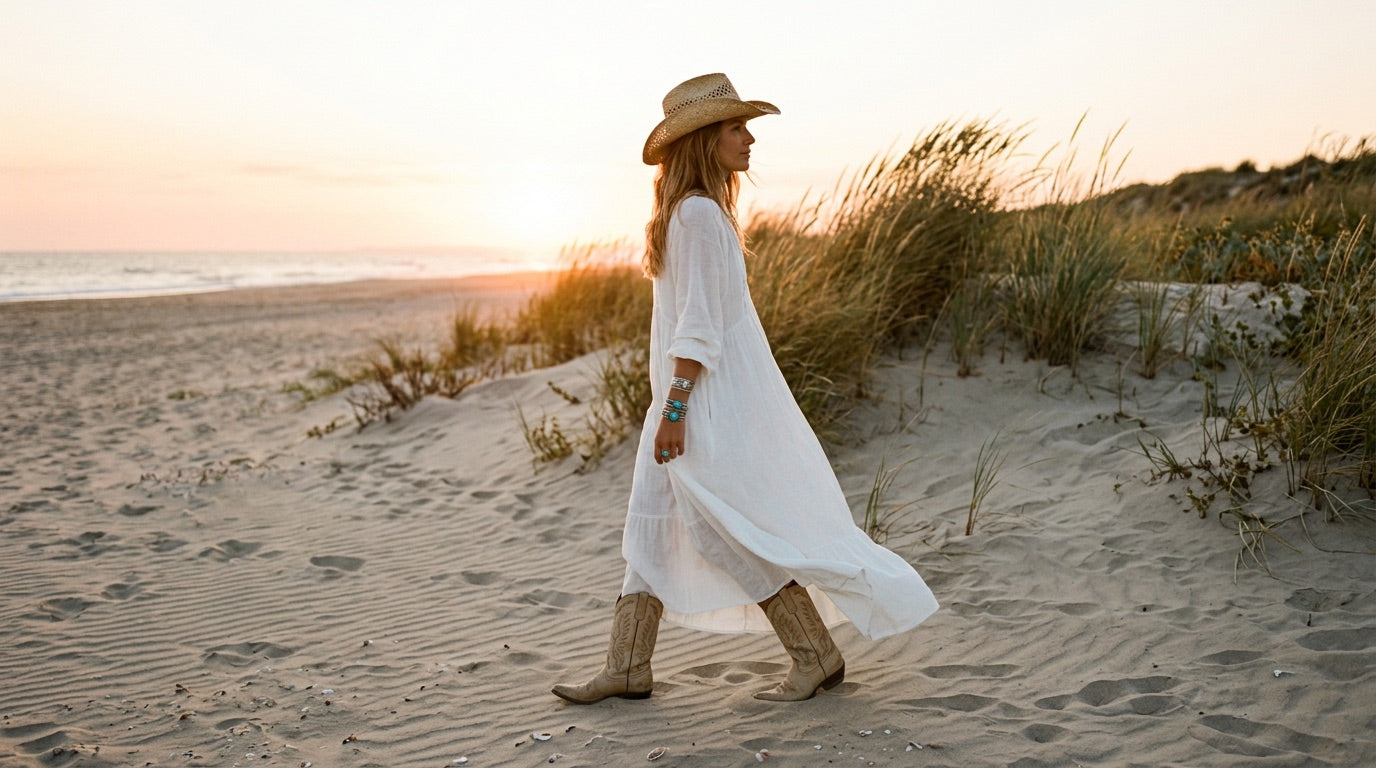
The cowgirl never left the ranches or rodeos, but in recent years she has made a strong comeback in popular culture and fashion. Modern cowboys and cowgirls in 2026 wear cowboy boots in town as well as at festivals. And on ranches and in arenas, many horsewomen continue to keep the profession alive, far removed from trends.
A whole museum dedicated to cowgirls
The history of cowgirls has long been less well preserved than that of cowboys. To address this, a museum was established in 1975, on a modest scale, in the basement of the Deaf Smith County Library in Hereford, Texas.
The collection moved to Fort Worth in 1994, and the National Cowgirl Museum and Hall of Fame opened its current building in the city’s cultural district on 9 June 2002. Every year, it honours women who embody the spirit of the West: ranchers, rodeo champions, artists and pioneers from other walks of life.
If you’re passing through Texas, it’s well worth a visit: through its objects and archives, the museum shows that the cowgirl isn’t a fictional character.
“Cowboy Carter”, the album that brought it all back
On 29 March 2024, Beyoncé released Cowboy Carter, an album that reimagines country music and its conventions. It went straight to number one on Billboard’s Top Country Albums chart, a first for a Black woman. On 2 February 2025, it won the Grammy for Album of the Year and Best Country Album.
Beyond the music, the album is a reminder of a reality that’s often overlooked: the American West has never been exclusively white, and the history of Black cowboys and cowgirls is part of this culture. In fashion, its imagery has put hats, fringe and cowgirl boots back in the spotlight.
Cowgirlcore and coastal cowgirl
On social media, cowgirl style has branched out into several “aesthetics”. Cowgirlcore means wearing cowgirl style every day and owning it: cowboy boots, a hat, jeans, a western shirt, and silver and turquoise jewellery.
Coastal cowgirl, popularised on TikTok in 2023 as a follow-on from “coastal grandmother”, combines western style with a seaside feel: lightweight dresses, sandy and white tones, a straw hat and light-coloured cowboy boots. We explore it in our complete coastal cowgirl guide.
There are plenty of variations in between, from rodeo glam to western bohemian. To find your own, read our article on western sub-aesthetics and different cowgirl styles.
The cowgirl look, piece by piece
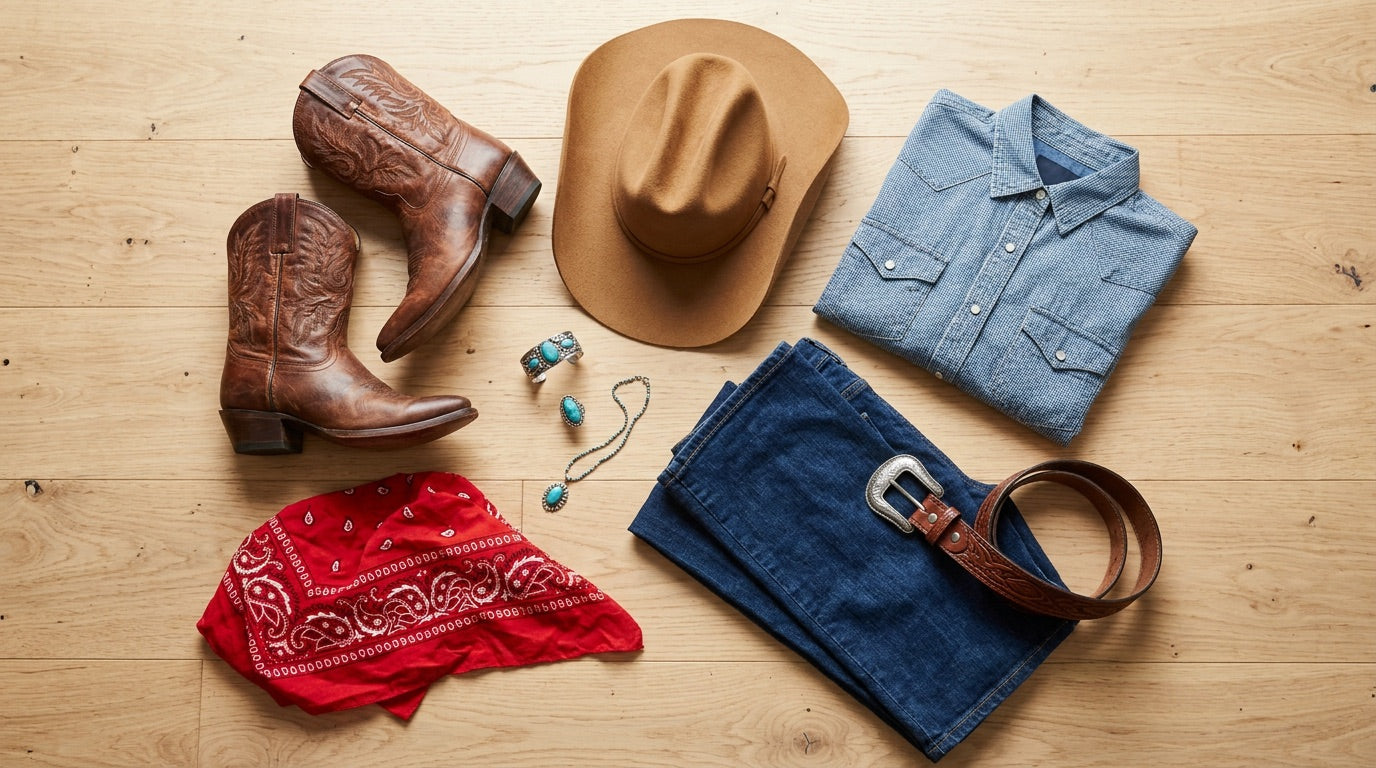
Cowgirl style grew out of work: every piece had a purpose before it became a signature. That’s what makes it so easy to wear; you just need to understand the role of each element. Here are the pieces that make up a western cowgirl outfit.
Cowboy boots
They’re the foundation. The angled heel stops your foot slipping through the stirrup, the tall shaft protects your leg and the pointed toe makes it easier to get your foot into the stirrup quickly. For your first pair, choose brown or black leather, which goes with everything. Our selection of women’s cowboy boots ranges from classic styles to more festive embroidered boots.
The cowboy hat
The hat protected cowboys from the sun and rain. Today, it’s the piece that instantly defines a look. Wear felt in autumn and winter, and straw in warmer weather. A women’s cowboy hat with a medium brim suits most face shapes.
The western shirt
Recognisable by its pointed shoulder yoke and snap buttons, the western shirt became popular in the mid-20th century, during the era of singing cowboys in films. Worn open over a vest top, tied at the waist or tucked into jeans, it’s extremely versatile. Take a look at our range of women’s western shirts.
Jeans
Raw or lightly faded denim in a straight or bootcut fit is the most authentic choice, as it sits neatly over cowboy boot shafts. Skinny jeans tucked into boots work too, for a more urban look.
The belt and buckle
A tooled leather belt, often finished with a large buckle, calls to mind rodeo trophies. It defines your silhouette and adds character to a simple pair of jeans. Choose a women’s western belt to match the colour of your cowboy boots.
Jewellery and the bandana
Silver and turquoise are classic western pairings, found in rings, cuff bracelets and necklaces. The bandana was used to protect against dust; tied around your neck, it adds a pop of colour. To finish the look, browse our western jewellery.
If you want a complete outfit without putting every piece together yourself, our cowgirl outfits collection brings together dresses, waistcoats, jackets and ready-to-wear sets.
Three ways to wear cowgirl style
- Everyday: straight-leg jeans, a white T-shirt, brown cowboy boots and a discreet buckle belt. It keeps the look without feeling like a costume.
- For a festival or country night out: a floral dress or ruffled skirt, light-coloured cowboy boots, a hat and a few silver pieces of jewellery.
- For a complete look: an embroidered western shirt, bootcut jeans, cowboy boots, a felt hat and a bandana. A confident nod to the cowgirls of the silver screen.
Mistakes that turn the look into a costume
The classic pitfall is piling on every piece at once: hat, fringe, checked shirt, waistcoat, bandana and an oversized buckle. The result looks more like fancy dress than a western cowgirl outfit. Stick to one or two statement pieces and keep the rest simple.
Another common mistake is overlooking the fit of your cowboy boots. A western boot should hold your instep. Your heel may slip slightly at first, but your toes should never be squeezed into the toe box. Finally, coordinate your leathers: a belt and boots in the same colour family are enough to bring the whole look together.
Shop our women’s cowboy boots →
Timeline: key dates in cowgirl history
This table brings together the key dates mentioned in the article, from women’s suffrage in Wyoming to the 2025 Grammy Awards.
| Date | Event | Why it matters |
|---|---|---|
| 1869 | Wyoming grants women the right to vote | The West becomes a place of greater opportunity for women on ranches |
| 1885 | Annie Oakley joins Buffalo Bill’s Wild West | The first female star of the Wild West shows |
| 1899 | Lucille Mulhall makes her debut in her family’s Wild West show | The woman often described as the first “cowgirl” |
| 1899 or 1901 | Prairie Rose Henderson rides a bronc at Cheyenne | Women enter rodeo events |
| 1913 | Fannie Sperry Steele wins at the Winnipeg Stampede | The golden age of women’s bronc riding |
| 1929 | Bonnie McCarroll dies at the Pendleton Round-Up | The start of women’s exclusion from rough stock events |
| 1935 | Patsy Montana records “I Want to Be a Cowboy’s Sweetheart” | A million records sold by a female country artist for the first time |
| 1944 | Dale Evans’s first film with Roy Rogers | The “Queen of the West” is born |
| 1948 | The Girls Rodeo Association is founded | Cowgirls organise their own rodeo association |
| 1975 | The cowgirl museum is founded in Hereford, Texas | At last, their history has a museum |
| 1981 | The GRA becomes the WPRA | Women’s rodeo becomes professional |
| 2002 | The museum’s building opens in Fort Worth | The National Cowgirl Museum establishes a permanent home |
| 2024 | Beyoncé releases Cowboy Carter | Cowgirl style returns to the pop spotlight in a big way |
| 2025 | Cowboy Carter wins Album of the Year at the Grammy Awards | Country music and its conventions reach the top of the music world |
Cowgirl FAQs
What is a cowgirl? What does the word mean?
A cowgirl is a woman who works with cattle on horseback on ranches in the American West. The word also describes rodeo riders and, more broadly, women who wear western style. She is the female equivalent of a cowboy.
What’s the difference between a cowboy and a cowgirl?
The work is the same: riding, gathering and caring for cattle, and maintaining the ranch. The difference is mainly historical: cowgirls were long given less recognition and, after 1929, were excluded from the most dangerous rodeo events. They responded by founding their own association in 1948.
Who was the first cowgirl?
Lucille Mulhall (1885–1940), from Oklahoma, is most often described as the first woman to be called a “cowgirl”, a nickname attributed to Theodore Roosevelt. Before her, Annie Oakley had already made women of the West famous through Buffalo Bill’s Wild West, but as a sharpshooter rather than a cattle horsewoman.
How do you dress like a cowgirl?
The basics are simple: cowboy boots, straight-leg or bootcut jeans, a western shirt and a leather belt with a buckle. Add a cowboy hat, some silver and turquoise jewellery, or a bandana, depending on the occasion. Two or three well-chosen western pieces are better than a full costume.
Should you write “cowgirl” or “cow-girl”?
Both spellings are used in English. The hyphenated form “cow-girl” still appears in some dictionaries, while “cowgirl”, as one word, follows the 1990 spelling reform and is now the more common form. The plural is “cowgirls”; “cow girl”, written as two words, is a common mistake.
What do cowgirlcore and coastal cowgirl mean?
Cowgirlcore means wearing cowgirl style every day, with cowboy boots, a hat, a western shirt and jewellery. Coastal cowgirl, popularised on TikTok in 2023, mixes these conventions with a seaside feel: light colours, floaty dresses, a straw hat and white or beige cowboy boots.
Sources
- Wikipedia (EN): Cowgirl
- Oklahoma Historical Society, The Encyclopedia of Oklahoma History and Culture: Mulhall, Lucille
- Wikipedia (EN): Annie Oakley
- National Cowboy & Western Heritage Museum: Breaking Trail: Bonnie McCarroll
- Wikipedia (EN): Women’s Professional Rodeo Association
- Wikipedia (EN): National Cowgirl Museum and Hall of Fame
- Wikipedia (EN): Patsy Montana
- Wikipedia (EN): Cowboy Carter


